Ads budget off Amazon, image translation, and full-funnel campaigns


On by default: Amazon spends your ads budget off Amazon
Sponsored Products already run off Amazon in Germany as well. What is new is the option “Increase reach off Amazon”, which is now on by default in campaign settings, without an announcement in the console and without you having opted in. Ads are then also served on sites outside Amazon such as Pinterest or BuzzFeed, in apps, and with content creators. Amazon confirms this as the default setting.
In the US this automatic delivery has existed for about a year, so the option can already be switched on and off there via bulk sheets. In Germany and the EU the feature is newer, and bulk-sheet control is still missing. That means every campaign has to be checked and edited manually in the console.


What this means for delivery
Off-Amazon placements run with the campaign’s existing targeting, bidding, and budget settings. The difference: on Amazon, delivery still follows keywords, products, and categories cleanly; off Amazon, that targeting no longer applies. There Amazon steers using its own user and purchase data, such as browsing and search behaviour, products viewed, and cart signals.
For niche products this becomes difficult: the fewer purchase signals Amazon has, the less precisely the platform can decide who should see the ad. Every one of those clicks comes out of the same budget that was planned for search and purchase on Amazon. Without a large budget you quickly pay for reach among people you never intended to reach.
Check and switch it
The setting can be changed at any time, but you have to go into each campaign manually and turn it off if you do not want to use it. In the ads console, open the individual campaign view and go to “Campaign settings”. At the very bottom you will find “Adjust reach on Amazon and off Amazon”. The option is not available when creating a new campaign, so you also have to open the campaign after setup and turn it off there.
Our recommendation
Before switching everything across the board, look at the numbers: How much budget does the product have, and can you afford to spend more? Does this setting fit the product’s strategy? Does it make sense, with that strategy, to be served off Amazon in the upper funnel? Those questions should be examined carefully. Independently of that, a general check is worthwhile: off-Amazon delivery is on by default, for existing campaigns as well as for every new setup. So check where this setting applies for you, and turn it off or constrain it where it does not fit the strategy or the budget.
Amazon will automatically translate product images into the customer’s language
Amazon now automatically translates text in product images into customers’ preferred language, in the US, Canada, Mexico, Brazil, Germany, France, Italy, Spain, the Netherlands, Belgium, Poland, Ireland, Sweden, and the UK. All sellers of non-media products on those marketplaces are affected. The translated images appear both on the product detail page and in the image manager.
How the rollout works
If Amazon detects an image that is not in the language of the respective marketplace, it is replaced with a translated version. In the US, Canada, Germany, Spain, and Belgium, Amazon goes further and also creates versions for individual customers’ different language preferences, such as Spanish for US customers or French in Canada. The original image in the store’s main language remains unchanged, as do brand elements, product specifications, and visual quality. Anyone who does not want automatic translation must upload their own images in the matching language. The AI version is then automatically removed from the product detail page.
Our recommendation
The process runs automatically, similar to titles already, and that is exactly where the risk lies. Amazon’s AI does not always make the best decision, and if nobody checks, a translation you have never seen – or, in the worst case, one that is wrong in context – ends up on your product detail page. You should therefore first check whether you even sell on the affected marketplaces and whether your images there are not already in the local language. If not, it is worth weighing the options: either regularly review what Amazon does with your images, or translate them yourself and upload them. For important ASINs the second route is safer, because you keep control of the message and the design.

You can find our popular Round Table and other news formats on our landing page.
Full-funnel campaigns: Amazon’s beta hands over control entirely
At unBoxed 2025, Amazon presented a new campaign format: full-funnel campaigns. What makes them distinctive is the combination of two previously separate worlds: performance-oriented Sponsored Ads that aim at concrete purchase intent at the bottom of the funnel, and reach formats such as audio, video, and display that build attention further up the funnel. Instead of managing several individual campaigns side by side, full-funnel campaigns recommend a personalised setup across Sponsored Products, Sponsored Brands, display ads, and streaming TV, tailored to where a brand has the best chance of reaching new customers and building long-term sales. Once the campaign is live, Amazon continuously adjusts budgets, audiences, and tactics and uses insights across all formats to optimise holistically.
Which role each funnel stage plays and which format serves it best is shown in the figure from our book Amazon Advertising, where besides the funnel you can also work through campaign structures, bids, audiences, and measurement.
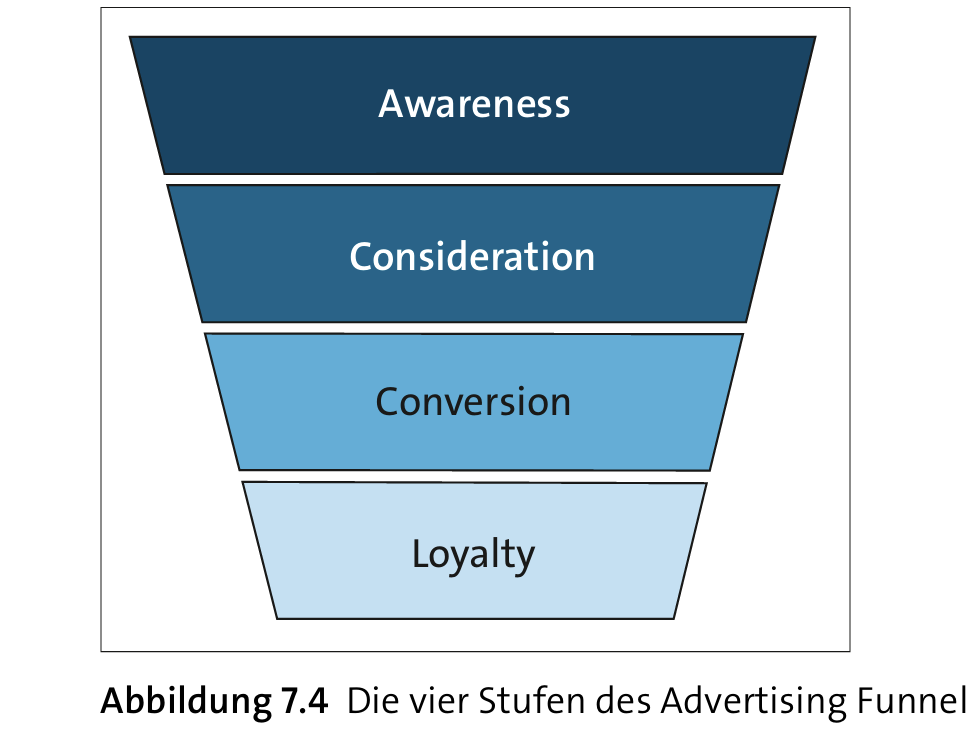
Amazon describes the flow of the new full-funnel campaign as follows: At the top of the funnel, streaming TV and audio start for reach and attention. Display and online video reinforce the message. Sponsored Ads take over at the end, delivering the actual purchase impulse. Amazon then continuously adjusts budgets, audiences, and tactics itself. There is no official availability or budget confirmation for Germany yet. Germany is, however, included in the marketplace details of the announcements.
First experiences with the campaign manager
In the US the format can now be tested and there are accordingly first reports; it is not yet available in Europe. Because it is still in beta, the option only appears sporadically in the ads console and offers little choice. This campaign type is intended as an easier and cheaper entry into Amazon DSP: through a full-funnel campaign, campaigns get access to data and reach that otherwise can only be achieved via DSP. However, that data cannot be viewed or controlled in full-funnel campaigns. Where the ads are served and in which format is decided by Amazon, and you trust that the automation will do the right thing with it.
Our recommendation
It sounds exciting, but should be treated with caution. You rely entirely on Amazon’s algorithm, data, and AI, and that has not always worked well in the past. Control sits completely with Amazon while your budget is running.
For smaller brands, niche products, or generally without a large advertising budget this can escalate quickly, because a full-funnel campaign requires a minimum budget of 200 dollars per day – already a lot of money for a single campaign. At the same time, 200 dollars is unlikely to be enough for a campaign that is supposed to serve streaming TV, video, display, and Sponsored Ads all at once.

In 2026, we are focusing on new marketing channels to keep you up to date with Amazon news: Our REVOIC podcast is published every Friday, and our YouTube channel has been fully revamped. Both now deliver fresh content regularly.
We look forward to your feedback!


Austria and Germany lead purchase frequency in Central European e-commerce in 2025, with 12.6 and 12.4 orders per online shopper per year.
Amazon launched AWD in Germany as well on 20 August, a flat-rate storage layer in front of the FBA network, but a fee table in euros is still missing.
Jeff Bezos is joining an investor group in Liverpool FC, but only takes a minority stake; control of the club remains with the existing owner FSG.